Do Not Resuscitate Do Not Track, Part III

Do Not Resuscitate

What a difference a year and a little election make. In 2007, the Marketing Consigliere blogged in Do Not Resuscitate Do Not Track Part I and Part II about the importance of government steering clear of regulation of behavioral targeting.

Late last week, the Federal Trade Commission issued a report entitled “Self-Regulatory Principles For Online Behavioral Advertising” advising the manner in which markete rs gather, store, collaborate and act upon data gathered from and about website visitors.  While basically echoing the Bush Administration’s hands-off approach, there was a slight change in philosophy and the Obama Administration did warn that the Federal government would be prepared to step in with regulation if the industry’s self-regulation could not clearly protect the privacy of online individuals.

According to the new FTC, there are four “governing concepts” by which marketers must continue to heed:

The first is transparency and control – marketers that gather data for behavioral advertising should disclose to website visitors in an explicit, understandable way the existence of such a practices and enable the visitor to choose whether or not to allow the practice.

The second principle advises reasonable security and limited data retention – marketers need to establish controls that ensure “reasonable” security of collected data, and should retain that data for only “as long as necessary for legitimate business or law enforcement needs.”

The third principle regards material changes to privacy policies – a user must be requested to give their consent before a marketer uses behavioral data in a way that is “materially different” from the manner in which it was originally explained how it would be used.

Lastly, the fourth principle dictates that marketers should obtain affirmative express consent before they use sensitive data for behavioral advertising.  Sensitive data includes but is not necessarily limited to minor status, health or financial information.

Ironically, the previous week, eMarketer reported in a newsletter about a ChoiceStream survey concluding that personally targeted advertising is desired as the dollar amount spent online by an individual buyer rises.

US Internet Users Who Are More Willing To Click On Ads If They Are Personalized

However, the same newsletter reports on a TRUSTe commissioned TNS Global survey that indicates that while most Americans are aware that data may be collected about them, many are uncomfortable with targeted ads even if the data used to serve the ads cannot be tied to their name.

US Adult Internet Users' Attitudes towards Advertisers Using Their Browser History for Advertiser Purposes

Additionally, a substantial number of Americans would opt out of receiving behaviorally targeted online ads even if they would then have to see ads they would never be interested in.

So while the Marketing Consigliere is still against this form of regulation that the new Administration may feel compelled to apply, he acknowledges that the Federal government may actually be listening to its constituents.

Marketers, don’t forget vox populi.

Your PURLsonal Brand

Brooks Brothers

The trend towards personalization in the B2C arena is gathering momentum.  This week an interesting announcement made the trade press regarding the famous brand Brooks Brothers – They are working with direct marketing company MBS to bring a unique one-to-one solution to their customers.  Using MBS’ Klondike relational database, Brooks Brothers will be able to integrate data from their call center, brick and mortar, and online efforts.   By also leveraging data modeling, data mining, and web analytics,  Brooks Brothers will be able to induce the morphogenesis of its current web storefront into a private “virtual closet,” which will depict all of a customer’s clothing and accessories purchased.  With such a visibility into this “virtual closet,” the customer or their favorite sales associate can review the wardrobe and make recommendations on new buys.

The personalization of the brand experience with Brooks Brothers seems to be a positive step for such a revered brand, espeically since brand management generally tends to be a risk averse discipline.  What could make this even more effective would be the inclusion of Personalized URLs (PURLs) for the virtual closets.  In a perfect world, a PURL is an easy to remember or recognize URL that an individual will associate as “theirs” because it uniquely identifies them as the “owner” of the online destination it represents.

While some Marketing folks think that “johndoe.abccompany.com” is a PURL, technically that is incorrect – that is a subdomain.  A true PURL would look like “www.abccompany.com/johndoe” and once clicked on would be able to dynamically generate content that is unique to that person, based on the combination of data fields referred to in the CRM tool that a marketer is using.

PURLs have been around a while, and while very popular with email campaigns, are bringing new life to direct print marketers.  The term “variable print marketing” basically means that marketers can conduct lead generation or campaign management events with the production of direct mail pieces that are unique to each and every customer.   Vendors such as PrintSf.com take this to an amazing level using XMPie‘s dynamic personalization engine.  For example, a Net-Centric Marketing professional can dynamically assign variable graphics, relevant content and personalized information on both sides of a postcard – in very sensational fonts.

PrintSf Variable Print Marketing

Now multiply that by the number of records in your CRM platform (In PrintSf.com’s case, they are an AppExchange partner with Salesforce.com), and you see that the possibilities are limitless.  With a call-to-action that requires visiting a dynamically generated PURL on each piece, the Marketer can now know exactly who is responding to a particular campaign and what they are doing on the landing page, which also can be personalized and optimized using tools from such popular vendors as Hubspot and Lyris.

The personalization of communications between brands and their customers will hopefully be creating more stronger relationships in the future.  You will be seeing more of this and if you haven’t received a direct marketing piece with your name in a PURL, you probably will in 2009.

Il Sottovoce – The Whisper – XVIII

The Marketing Consigliere

La ragione è del piu forte.  Contra la forza la ragion non vale.

Might is right.

The Malls Have Eyes…

The Malls Have Eyes

In a Marketing Consigliere blog from last year, it was noted that the integration of eye analytics and ultrasound by companies such as Influence Media make possible the delivery of audio messages to precise spots in a public space, based on eye contact .  Another blog from around the same time described the possibility of using video and off-the-shelf technologies to profile automobiles entering a parking lot and target messages via digital signage as shoppers enter stores.

Now, a year later, a recent wire by AP’s Dinesh Ramde that was run in a multitude of publications documents another stage in the evolution of net-centric marketing in a retail environment.  The headlines ran “When you’re watching an ad, it might also be watching you,” or “…checking you out.”

This may be rather alarmist, but the truth is that the B2C advertising world is trying to get more personal – literally.  TrueMedia Technologies, Inc. is one of the companies mentioned in the article that is leading the march – using its video analytic technology combined with technology from dZine, a kiosk placed strategically in a mall can determine a person’s gender, approximate age, and sometimes ethnic background.  Base on the determination, the kiosk’s digital signage can serve an ad that may be relevant to the profile of the viewer.  The gender identification accuracy is about “85 to 90″ percent accurate, but the ability to identify the other characteristics need some improvement.

While this is another step of progress for net-centric marketing, there is still a long way to go.  A 30-something white woman may be there to get a toy for her child, and not care about the lingerie sale at Victoria’s Secret. But how far could this go if a marketer wanted to push this?  Based on a physical shape, could the kiosk serve ads on the local food court, GNC, Jenny Craig, or Gold’s Gym?  Do people want to be publicly served an ad that could betray a need they may want people looking over their shoulders to see?  Could other types of sensors be employed to gather metrics such as cologne worn, pulse, what kind of electronics once could be carrying?

Without other correlatable data such as the type of car the person drove in with or zip code, or some other type of video analtyics such as that used by the security industry, predictive anlaysis or behavioral targeting is not feasible.  Maybe data and capability carried around on an “opted in” cellphone by an individual (Google Latitude, anyone?) could facilitate a much more rewarding engagement if someday integrated with this type of system.  For now, it will probably stir up more controversy than it deserves.

But once again, this is just the beginning.  We will get there..

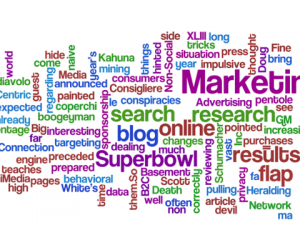
The Marketing Consigliere Wordle

Sometimes a frivolous thing can be fun and artful.  Here is the Wordle for the Marketing Consigliere blog.

Marketing Consigliere Wordle

SuperAds XLIII

The Marketing Consigliere prepared himself for Superbowl XLIII by reviewing his guest blog at Scott White’s blog, The Big Kahuna.  He thought it would be interesting to see how far Marketing has come in a year.

Superbowl XLIII

This year’s Superbowl had some well announced changes such as GM pulling out of its long time sponsorship.  Fine – not everyone was willing to pay $3,000,000 for a spot this year.   While no agency stood out significantly among the crowd, there were definitely some bombs.  Brand management professionals may need to think hard for next year. [Read more...]