More Sounding Off on Ultrasound

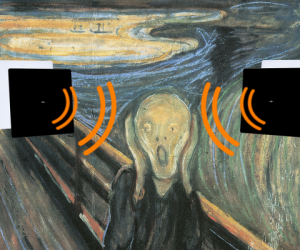
The Marketing Consigliere received many emails regarding last week’s blog, “Sounds Like REALLY Targeted Advertising to Me.”  Several people, while liking his adaption of the Munch’s The Scream, wanted to know where ultrasound advertising was really being used.

He found an example on YouTube – the A&E Channel was promoting it’s Paranormal State show. The picture below is a still of the billboard on the side of a building near Mulberry Street and Mott Street in lower Manhattan, New York City. You can clearly see the speakers pointed down towards the pedestrians below. Below that is a video of the ultrasound speakers working.

A&E’s “Paranormal State” Billboard

Now listen closely…

That’s all we need… more people walking around the streets of major cities thinking that they hear something…

Il Sottovoce – The Whisper – IV

The Marketing Consigliere

Batti il ferro quando è caldo.

Strike when the iron is hot.

Sounds Like REALLY Targeted Advertising to Me

In the April 2008 Wired in “It’s All in Your Head,” Clive Thompson recently wrote about technology beaming to our heads and the inevitable civil rights battle over the act of doing so. While it is reminiscent of my February blog entitled “EmSense – Common Sense or Nonsense?,” it’s not about mind reading but about mind influencing – through advertising.

The interesting technology, ultrasound, creates sounds whose wavelengths in the millimeter range, and therefore can be projected in a very narrow, relatively straight beam – think laser, but not necessarily “pinpoint.” It’s actually been around for a number of years but hasn’t been heard about much (no pun intended). But with price points dropping and range of depth increasing, you probably will hear more about it (again, no pun intended).

AudioSpotAmerican Technology Corporation

I quickly found two North American based companies that appear to be leaders in this field: Holosonic Research Labs of Watertown, Massachusetts, and American Technology Corporation of San Diego, California.

Influence Media of Langley, British Columbia, is an American Technology Corporation reseller and has a very interesting platform in its EyeBox2/EyeAnalytics product. With it, you can “see” who is looking at your billboard/hi-def screen, prop, or whatever, and deliver a “private” message to that individual that only he or she can hear.

I believe the concept is both interesting and feasible, and it will likely be successful for the early adopters. While there may be some suspicion at first by privacy rights groups and some consumers, the real problem will be when this type of advertising proliferates.

Advertising Delivery using Eye Analytics and Ultrasound

The Scream, by Edvard Munch (1863-1944), National Gallery, Oslo

Once price points allow a large scale of it, there could be an almost spam-like deluge of it in our streets, malls, arenas and other public places where sometimes we just want to think. Can you imagine those speakers on buildings everywhere like cell antennae, pointing down every which way? Will municipal governments have to draft new regulations for this technology to keep parks, beaches, hospital zones, schools, libraries, etc. free from such marketing? Would taggers spray paint sidewalks so people could know where to walk without getting “assaulted?”

Would there be other “backlash” that some enthusiastic Net-Centric Marketers did not anticipate? Hmm. I better find a quiet place to think about it…

From An Endless Stack of Trade Rags to Read

Here are a couple of excerpts from articles that The Marketing Consigliere read over the holiday weekend.

Marketing Management Magazine

“Marketing as a whole must get smarter – not only search. Mass marketing has long fallen from favor, yet we are inundated no less than ever with masses of irrelevant marketing. Personal empowerment can be built only with tools that deliver offers and information of high personal relevance. It’s not the amount but the relevance of what we know that drives success – so marketing, search especially, must smarten up.”

J. Walker Smith, President, Yankelovich Monitor

From “Smart Search – Marketing needs to smarten up,”Marketing Management, March/April 2008, p. 52

Yes and thank you, Mr. Smith, for pointing out what needs to be POUNDED into the heads of corporate leadership. We are now on entering an era of true Network Centric Marketing and there are companies that have to be dragged kicking and screaming into it.

Marketers can get smarter, but like most solid education, it takes money. CEOs, make the investment in your marketing IT infrastructure, not only in keywords. Give your CMOs and VPs the money they need to align with sales and produce key, measurable results. And don’t pull the plug on marketing when the going gets tough. Unless marketing hasn’t smarted up…

Advertisiing Age Logo

“The basic point about the web is that it is not an advertising medium. The web is not a selling medium. It is user controlled, so the user controls, the user experiences.”

Jakob Nielsen, Web Designer, The Art Bin

From “Think different: The web’s not a place to stick your ads” Advertising Age, March 17, 2008 p. 3

No, no, Jakob. You were quoted saying that ten years ago and someone foolishly thought to exhume that statement again.

The web is a medium for information processing – and it is a two-way medium. And marketers have every right to use the web as part of a Network Centric strategy that allows them to gather, clean, store, share and act upon data through that medium. The web is not user-controlled in the absolute sense…thank heaven. That is so because one can say that the web is “marketing influenced.” Think about it.

Il Sottovoce – The Whisper – III

The Marketing Consigliere

In un mondo di ciechi un orbo è re.

In a world of blind people, a one-eyed man is king.

Phorm an Opinion…

Across the pond there has been a storm brewing over privacy and advertising. The largest Internet Service Providers in the United Kingdom – BT, Virgin Media and Carphone Warehouse’s TalkTalk, recently teamed up with Phorm , an ad serving company. In this unusual move, ISPs, which have been traditionally “neutral” to end users web surfing habits, now have an opportunity to cash in by “knowing” what their customers do. So by providing the behavioral data of their customers, ISPs will get paid by Phorm, who will be able to serve customized ads that actually may appeal to those end users. Or so the conventional wisdom goes…

Phorm Logo

Of course, privacy advocates are not happy. Even the Father of the World Wide Web, Sir Tim Berners-Lee, has indicated he would change providers if his ISP were to do something like this. There is a somewhat valid point that people have to “opt out” of this service – and no doubt the ability to opt out will be buried in the fine print of the user agreement each new customer will have to sign.

But do they really think that the people running the ISPs and advertisers will be looking at individual records? Net-centric marketers, you may have a public relations challenge on your hand, but I’ve blogged about this before and I believe that the automation of marketing as a mechanism to react to behavioral-based events on the Internet is inevitable. It will be too efficient to ignore, especially when enough data builds up to perform fruitful data mining.

The real privacy invasion would occur if there was a security breach and this type of information was stolen by spammers, who up to this point have marketed using the “shotgun” method, hoping to hit something while blindly “firing” into a crowd. I admit that has high probability of occuring because of a spammer can pay either a hacker or disgruntled employee to obtain the data.

Just as bad would be a “cascading” effect, where marketers decide to take that data and use other channels, such as direct mail and telemarketing to reach new customers. So the data doesn’t just stay on the web in the form of custom served ads – it cascades into other media forms to “invade” our privacy.

But just as we put up with the bane of spam because overall email is important, we will have trade-offs for the benefits of the net-centric marketing world. And I’d rather see an ad that interests me instead of some wierdly dancing woman who’s part of a bottom-feeding mortgage ad…